Tracking AI visibility has become a standard part of marketing strategy, whether you call it GEO, generative engine optimization, or AI SEO.
Ask ChatGPT, Perplexity, or Gemini for a recommendation and you’ll usually get a handful of names back. For a business, the question is pretty simple: Are you one of them?
Until recently, keeping tabs on that sort of thing wasn’t especially practical for smaller companies. The tools were expensive, and AI visibility was largely something bigger brands had the time and budget to think about. That’s not really true anymore. Prices have come down, and small businesses, SaaS teams, and agencies can now see how they’re showing up in AI results without spending hundreds of dollars every month. Some tools cost less than $50.
Of course, cheaper doesn’t automatically mean useful. Different tools track different AI platforms, and the features you get for the price vary quite a bit. We went through the options with those differences in mind, looking for the ones that make the most sense for smaller businesses and budgets.
Searcherries comes out on top. Plans start at $10 a month with annual billing, or $13 if you pay monthly, making it the least expensive paid option in this guide. That entry-level plan also tracks ChatGPT, Perplexity, Google AI Overviews, Gemini, Claude, and Grok. None of the other tools we looked at include all six at their starting price.
Searcherries connects with Google Analytics 4, Google Search Console, and Bing Webmaster Tools, so you can see whether AI mentions actually lead to website visits. It also includes an MCP server, allowing Claude, Codex, or Cursor to access your data.
The rest of this list covers situations where another tool may be a better fit, including local listings, article writing, traditional rank tracking, hundreds of prompts, and enterprise-level requirements.
Searcherries is our product, so we can speak most confidently about our own current pricing and features. For every other tool, the figures in this guide come from the vendors’ pricing pages as of September 2026, which are linked in the table below. Pricing and plan limits change frequently, so if you spot something that’s no longer accurate, let us know, and we’ll correct it.
What a small business should look for
Five things matter most when choosing an AI visibility tool on a small-business budget.
- Price the plan you’ll actually use. Several tools advertise an inexpensive entry plan but charge extra for individual AI engines. Otterly’s $29 plan, for example, excludes Gemini, Claude, and Google AI Mode, with each available as an add-on costing between $9 and $29 a month. Frase includes two engines for $49, while Claude and Gemini are reserved for its $299 plan.
- Check which AI platforms are included. Your customers may be using ChatGPT, Google, Perplexity, Gemini, Claude, and Grok. A plan that tracks only two of them gives you a limited view of the answers your customers are seeing.
- Count how many prompts you realistically need. Most small businesses can get useful data from tracking 5 to 20 customer questions on a schedule. A 200-prompt allowance may sound impressive, but it doesn’t add much value if your business will only act on a dozen.
- Look for analytics integrations. Knowing that your brand appeared in an AI answer is useful. Knowing whether that mention led to clicks, sessions, or conversions is much more useful. A tool that connects with GA4, Google Search Console, and Bing Webmaster Tools can put AI visibility alongside the traffic it produces.
- Consider whether your AI assistant can access the data. An MCP server allows tools such as Claude, Codex, or Cursor to read your tracking data and answer questions about it. Otterly, for comparison, reserves MCP and API access for its $189 Standard plan.
AI visibility and AI SEO tools for small businesses compared
The table is sorted according to how well each tool fits the needs of a small business. The entry price is the lowest monthly cost at which you can begin tracking AI answers. Each price links to the vendor’s pricing page. Every tool name also links to a plan-by-plan comparison with Searcherries.
| Tool | Entry price | Prompts on that plan | AI platforms on that plan | Best for |
|---|---|---|---|---|
| Searcherries | $10/mo on annual billing ($13 monthly); Pro $59/mo | 10 question units: 10 questions on 3 platforms, or 5 on all 6 | 6 on every plan: ChatGPT, Perplexity, Google AI Overviews, Gemini, Claude, Grok | Best overall value for small businesses, agencies and SaaS |
| Otterly | $29/mo Lite ($25 annual); Standard $189/mo (pricing) | 15 | 4: ChatGPT, AI Overviews, Perplexity, Copilot. Gemini, AI Mode and Claude are add-ons | Daily checks on a short prompt list |
| BrightLocal | $39/mo per location (Track); Manage $49, Grow $59 (pricing) | Per location, not per prompt | 2: ChatGPT and Google’s AI | Single-location businesses that also need local SEO |
| Frase | $49/mo Starter ($39 annual); Scale $299/mo (pricing) | Not published per plan | 2 on Starter: ChatGPT, Google AI. Perplexity from $129/mo, Claude and Gemini from $299/mo | Content teams that want writing tools with tracking attached |
| Writesonic | $79/mo Starter; Basic $199, Growth $399 (pricing) | 50 | 3 on self-serve plans: ChatGPT, Gemini, AI Overviews. Perplexity, Claude and Grok on Enterprise only | Teams that want articles and site audits in the same subscription |
| Nightwatch | €79/mo Starter; Professional €159 (pricing) | 50, with 1,500 AI answers a month | 6: ChatGPT, Claude, Gemini, Perplexity, AI Mode, AI Overviews | Teams that need daily rank tracking as well |
| Surfer | €82/mo AI Search Analytics (billed yearly); content plans €49–€299 (pricing) | 50, refreshed daily | 5: ChatGPT, Perplexity, AI Mode, AI Overviews, Gemini | Content teams already writing in Surfer |
| Peec AI | $95/mo Starter (€89); Pro $245/mo (pricing) | 50 | 3 of your choice from ChatGPT, AI Mode, AI Overviews, Copilot, Perplexity and Gemini. Claude and Grok on Enterprise only | Marketing teams that present reports to clients or a CMO |
| SE Visible | $99/mo Basic ($79 annual); Core $189/mo (pricing) | 200 | 6: ChatGPT, ChatGPT Search, Perplexity, AI Overviews, AI Mode, Gemini | Long prompt lists: 200 prompts on the entry plan |
| Semrush One | $99/mo per domain, billed annually; inside Semrush One from $199/mo (pricing) | 25, checked daily | 4: ChatGPT, Google AI, Gemini, Perplexity | Teams that already work in Semrush |
| Ahrefs Brand Radar | Custom prompts from $50/mo on top of an Ahrefs plan (Lite $129/mo); AI Visibility Index $199/mo per platform (pricing) | 5 custom prompts and 150 checks a month on Lite | 7 for custom prompts: AI Overviews, AI Mode, ChatGPT, Perplexity, Gemini, Copilot, Claude | Ahrefs customers who want to research prompt demand |
| Profound | Not published; Enterprise after a demo (pricing) | 50 a day on the trial; custom after | 3 on trial; 9 on Enterprise | Enterprise marketing teams and agencies |
Searcherries is the only tool in the table that covers six AI platforms for less than $79 a month, while every other paid tool starts at $25 a month or more. The next two tools offering six platforms, Nightwatch (€79) and SE Visible ($99, or $79 with annual billing), do not include Grok.
Among the tools with published pricing, Searcherries is also the only one that tracks both Claude and Grok on its entry-level plan. Nightwatch and Ahrefs cover Claude, while Grok appears elsewhere only on the enterprise tiers of Writesonic and Peec AI.
For plan-by-plan figures on 14 tools, including the four that cost less than $50 a month, see our guide to AI visibility tool pricing in 2026.
The 12 best AI visibility tools for small businesses
1. Searcherries: Best overall value for small businesses
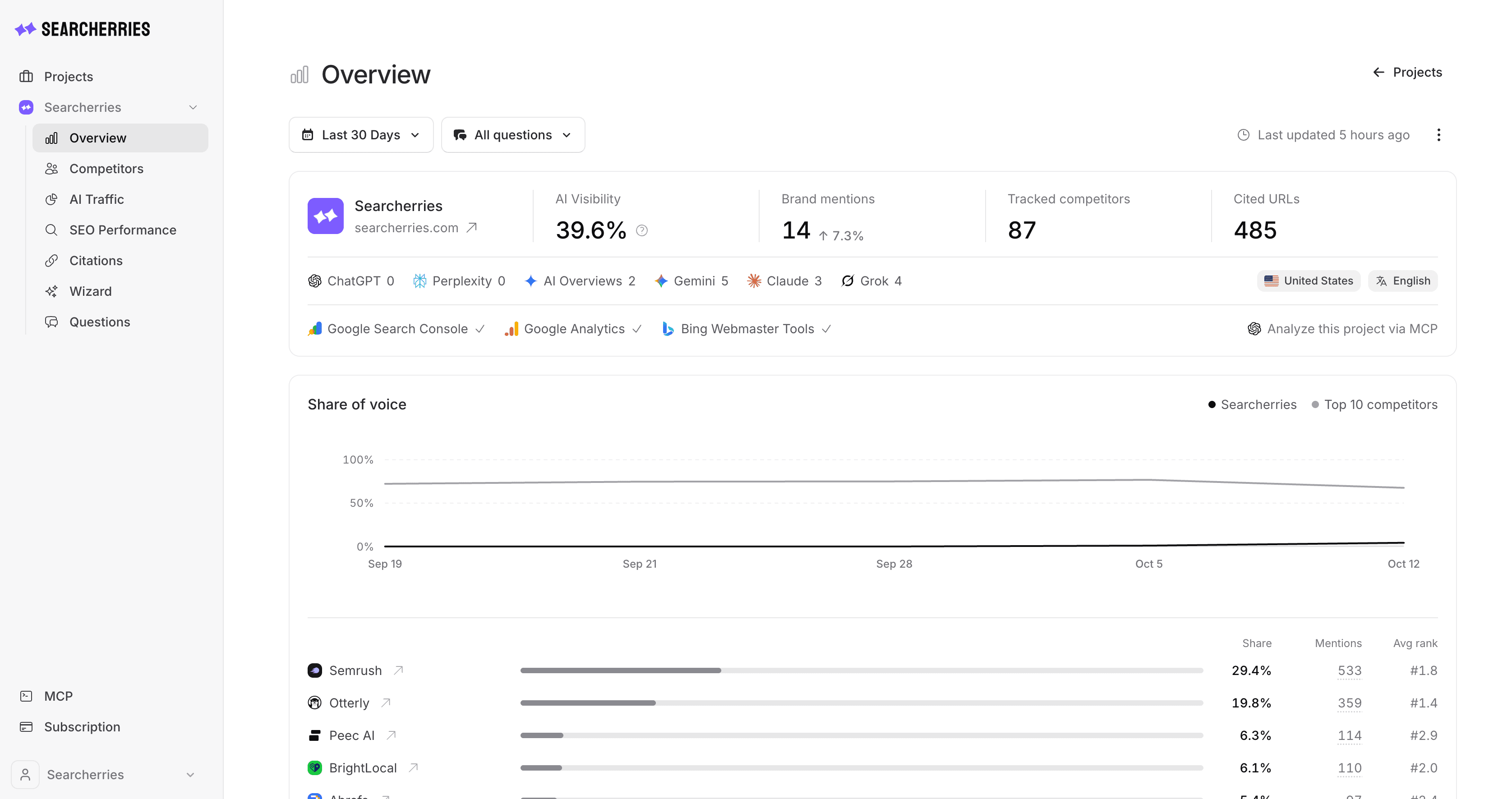
Searcherries collects AI answers on a schedule based on the specific questions your customers ask. Instead of relying on a sample pulled from a large, general database of brand mentions, you can track what AI platforms say in response to the questions that actually matter to your business. This differs from the approach used by free tools such as the Ahrefs and Semrush checkers.
Starter costs $13 a month, or $120 a year, bringing the effective monthly price down to $10. Pro costs $59 a month, or $47 a month with annual billing, and supports up to 10 active projects. That makes it possible for a small agency to manage several clients while staying under $50 a month.
Every plan includes all six supported AI platforms: ChatGPT, Perplexity, Google AI Overviews, Gemini, Claude, and Grok. There are no additional per-engine charges.
Projects can also be configured by country and language. A dentist in Austin, for example, can track answers for the U.S. market while a SaaS company selling in Spain can monitor the market relevant to its own customers.
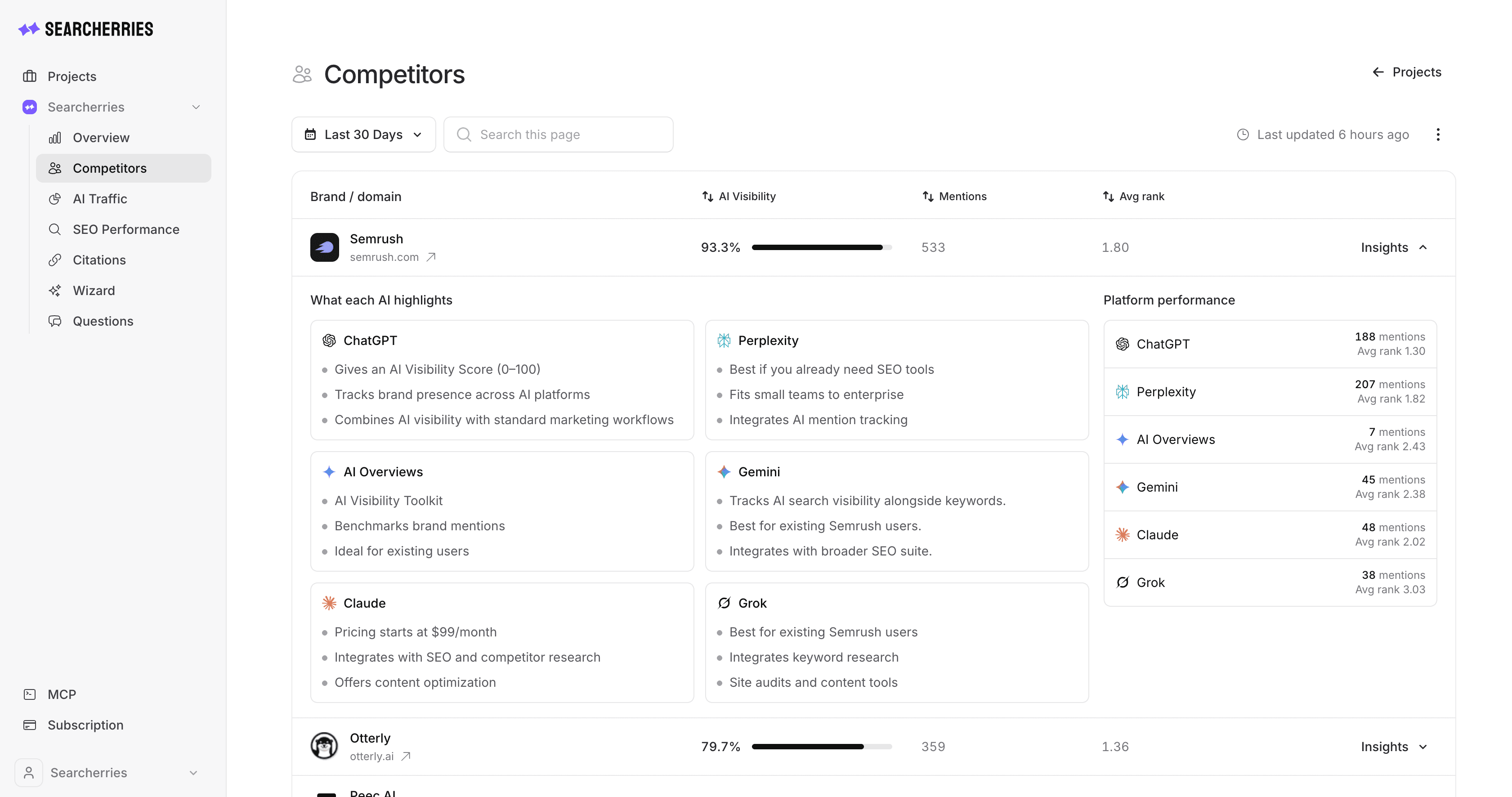
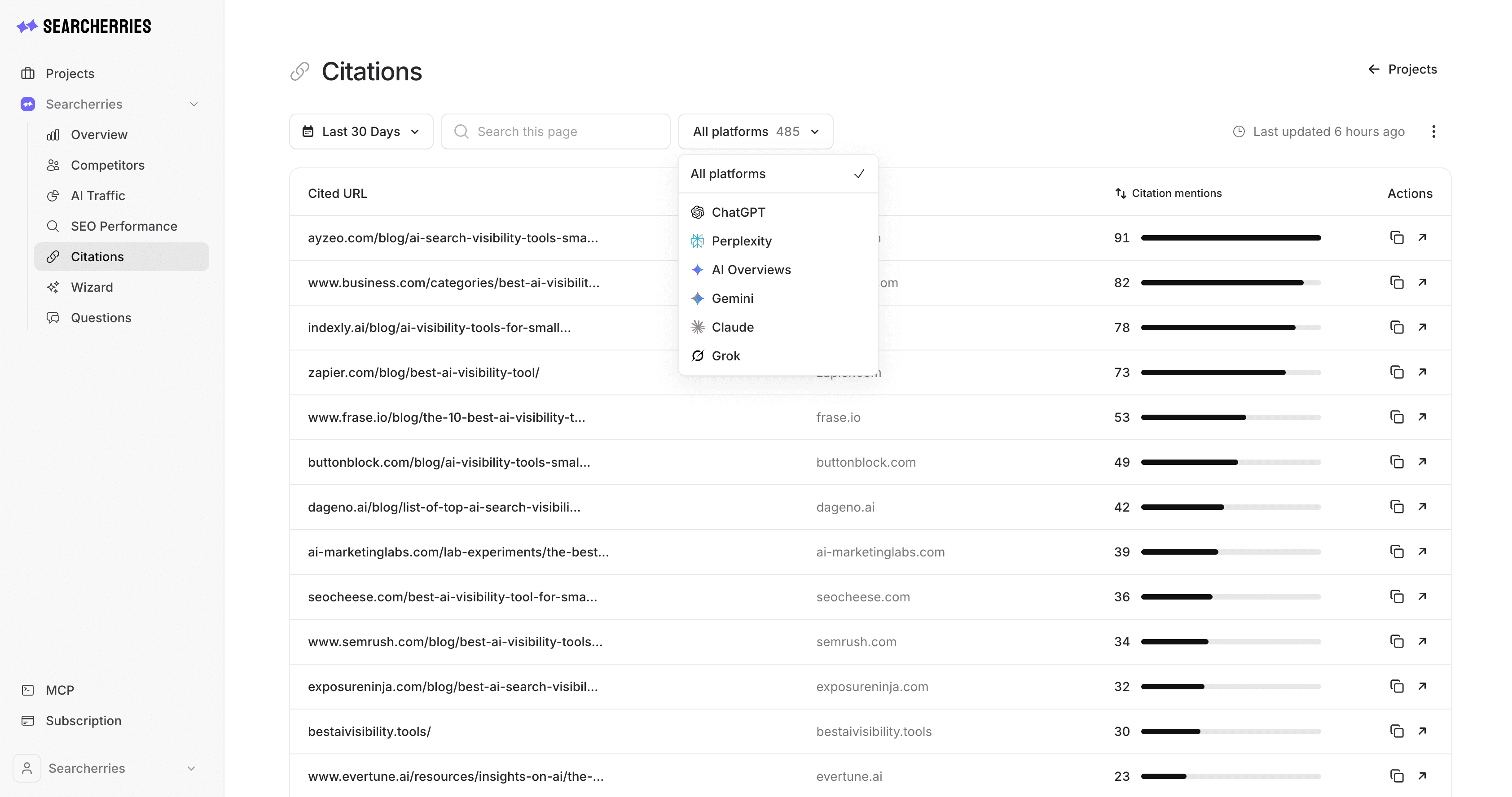
Searcherries identifies competitors directly from the AI answers it collects. You can see which brands appear alongside yours, how frequently they’re mentioned, and where they tend to rank. The Citations report then shows the URLs being cited by AI platforms, helping you identify pages and websites where earning a mention could improve your visibility.
From $10 a month, the lowest price in this guide
At $10 a month with annual billing, Searcherries Starter is the lowest-priced paid plan included here. Under comparable annual billing, Otterly starts at $25, Frase at $39, and BrightLocal at $39 per location. Tools aimed more heavily at marketing departments generally begin in the $79 to $99 range.
Starter includes 10 question units each month. Tracking one question across three platforms uses one unit, while tracking it across all six uses two. In practice, that means you can monitor 10 questions across three platforms or five questions across all six. A 7-day free trial is also available.
GA4, Search Console, and Bing on every plan
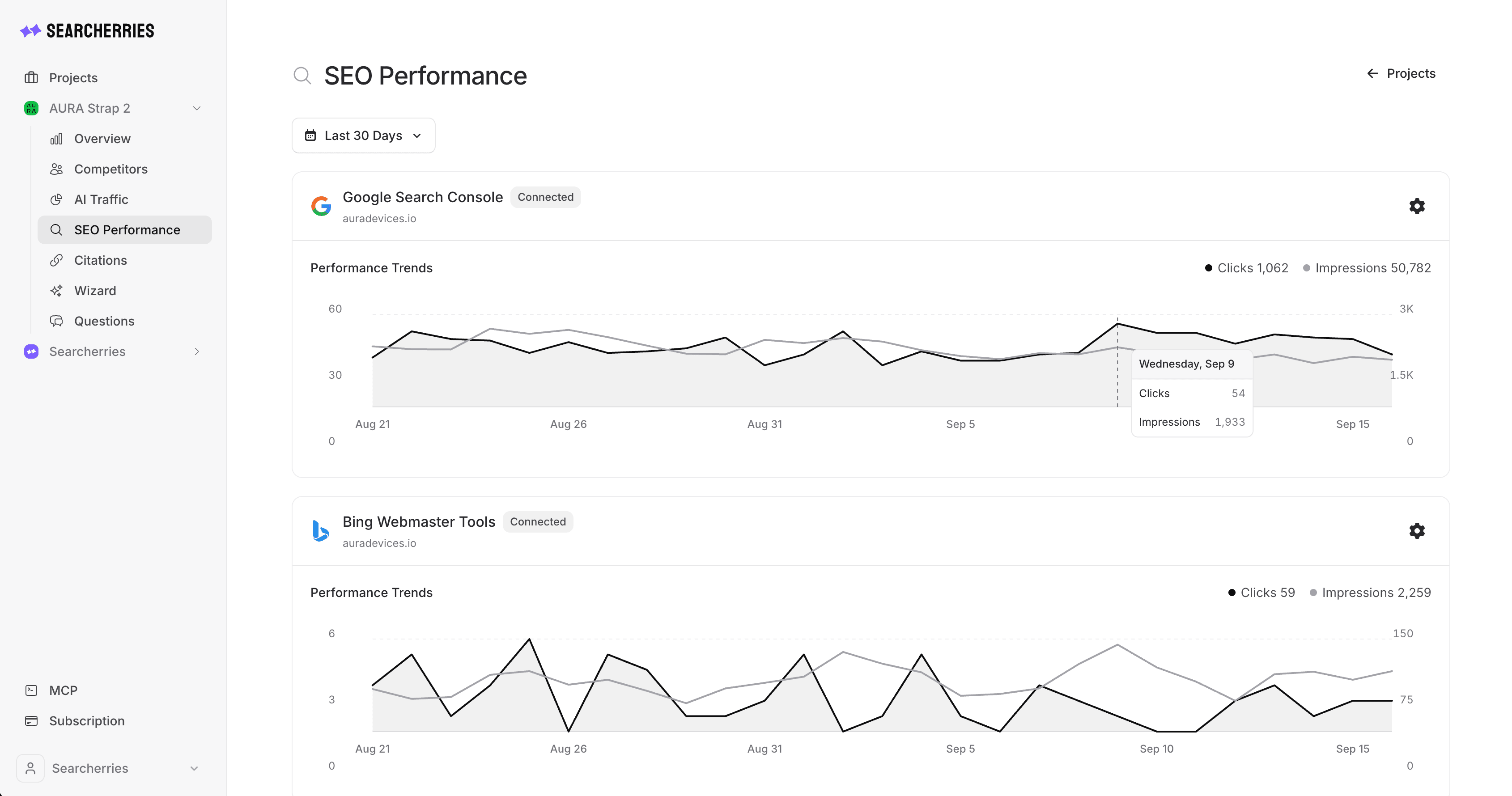
Connect Google Search Console and Bing Webmaster Tools to see organic clicks and impressions alongside your AI answers. The Questions section also identifies question-based searches people already use to find your site through Google, giving you ideas for what to create or optimize next.
Google Analytics 4 adds another layer. The AI Traffic report shows visits from ChatGPT, Perplexity, Gemini, and other AI assistants, including sessions, engaged sessions, conversion actions, and landing pages. Instead of simply knowing that ChatGPT mentioned your business, you can see whether that visibility translated into traffic and leads.
All three integrations are available on the $10 plan, with setup handled through your Google or Microsoft account. With many other tools in this guide, organic search performance and AI referral traffic remain separate from AI visibility tracking, requiring you to compare the data across different products.
A full MCP server on the $10 plan
Searcherries includes a read-only MCP server on both Starter and Pro. Claude, Codex, Cursor, VS Code, and other MCP clients can connect to it and access stored AI answers, competitor data, cited URLs, Search Console and Bing performance, and GA4 AI traffic across your projects.
The server can also generate a prioritized action plan and provide the evidence behind each recommendation.
Because the analytics integrations and AI tracking live within the same project, your assistant can work with both sets of information in a single conversation. You might ask Claude which competitors Perplexity recommends instead of your business and which pages it cites, then follow up by asking which of your own pages already receive impressions for those questions.
Otterly offers MCP and API access beginning with its $189 Standard plan. Searcherries’ MCP usage does not count against your Wizard questions. Wizard, the platform’s built-in assistant, includes five questions a month on Starter and 10 on Pro.
There are limitations. Searcherries doesn’t offer white-label PDF reports or an article writer. Agencies that need reports under their own branding may prefer Frase’s Scale plan, while businesses tracking hundreds of prompts may get better volume from SE Visible.
2. Otterly: Daily checks on a short prompt list
Otterly is one of the better-known entry points into AI visibility tracking. Its Lite plan costs $29 a month, or $25 with annual billing, and includes 15 prompts checked daily across ChatGPT, Google AI Overviews, Perplexity, and Microsoft Copilot. It also includes unlimited team members.
Gemini and Google AI Mode cost an additional $9 a month each, while Claude costs another $29. Adding Gemini and Claude to Lite brings the monthly total to $67.
The next tier, Standard, jumps to $189 a month for 100 prompts and adds API and MCP access.
Otterly is a solid fit for a solo marketer who wants daily tracking for a short list of prompts and doesn’t need Gemini or Claude. However, organic search and AI referral traffic still need to be monitored elsewhere, so you’ll have to combine data from multiple tools if you want the full picture.
3. BrightLocal: Local SEO with AI tracking attached
BrightLocal is primarily a local SEO platform, offering geo-grid rank tracking, citation management, Google Business Profile tools, and review features. In 2026, it added a Local AI Visibility Tracker for ChatGPT and Google’s AI, along with AI Insights that turn the results into recommended actions.
The Track plan costs $39 a month per location, with a 25% discount for annual billing.
For a dentist, restaurant, or other business operating from a single location, that gives you a lot of functionality for the price. The economics become less attractive for franchises and other multi-location businesses because pricing is calculated per location.
Its AI coverage is also limited to two platforms. Perplexity, Gemini, Claude, and Grok are not currently included in the tracker.
4. Frase: A writing suite with AI tracking included
Frase began as a content research and optimization platform and added AI visibility tracking to its plans in 2026.
Starter costs $49 a month, or $39 with annual billing, and includes 10 AI articles, 50 audit pages, and visibility tracking across ChatGPT and Google AI. Perplexity becomes available on the $129 Professional plan, while Claude and Gemini are reserved for Scale at $299. Scale also includes white-label reports and a client portal designed for agencies.
If you’re already interested in Frase for its writing and content optimization tools, AI visibility tracking is a useful addition. If tracking is your primary goal, however, you may end up paying for article generation and auditing features you rarely use. The Claude and Gemini coverage reserved for Frase’s $299 tier, for example, is available on Searcherries’ $13 monthly plan.
5. Writesonic: Tracking bundled with a writer and audits
Writesonic has repositioned itself around AI search visibility, combining tracking with an AI article writer, site audits, and an Action Center that recommends prioritized fixes.
Starter costs $79 a month for 50 prompts, Basic costs $199 for 100, and Growth costs $399 for 200. All three self-serve plans track ChatGPT, Gemini, and Google AI Overviews. Perplexity, Claude, Grok, and seven additional platforms are limited to Enterprise.
Writesonic makes the most sense when you want AI visibility tracking, content generation, and site auditing under one subscription. A small business interested primarily in whether AI assistants recommend its products or services may find that much of the $79 monthly cost goes toward features it doesn’t need.
6. Nightwatch: A rank tracker with AI prompts added
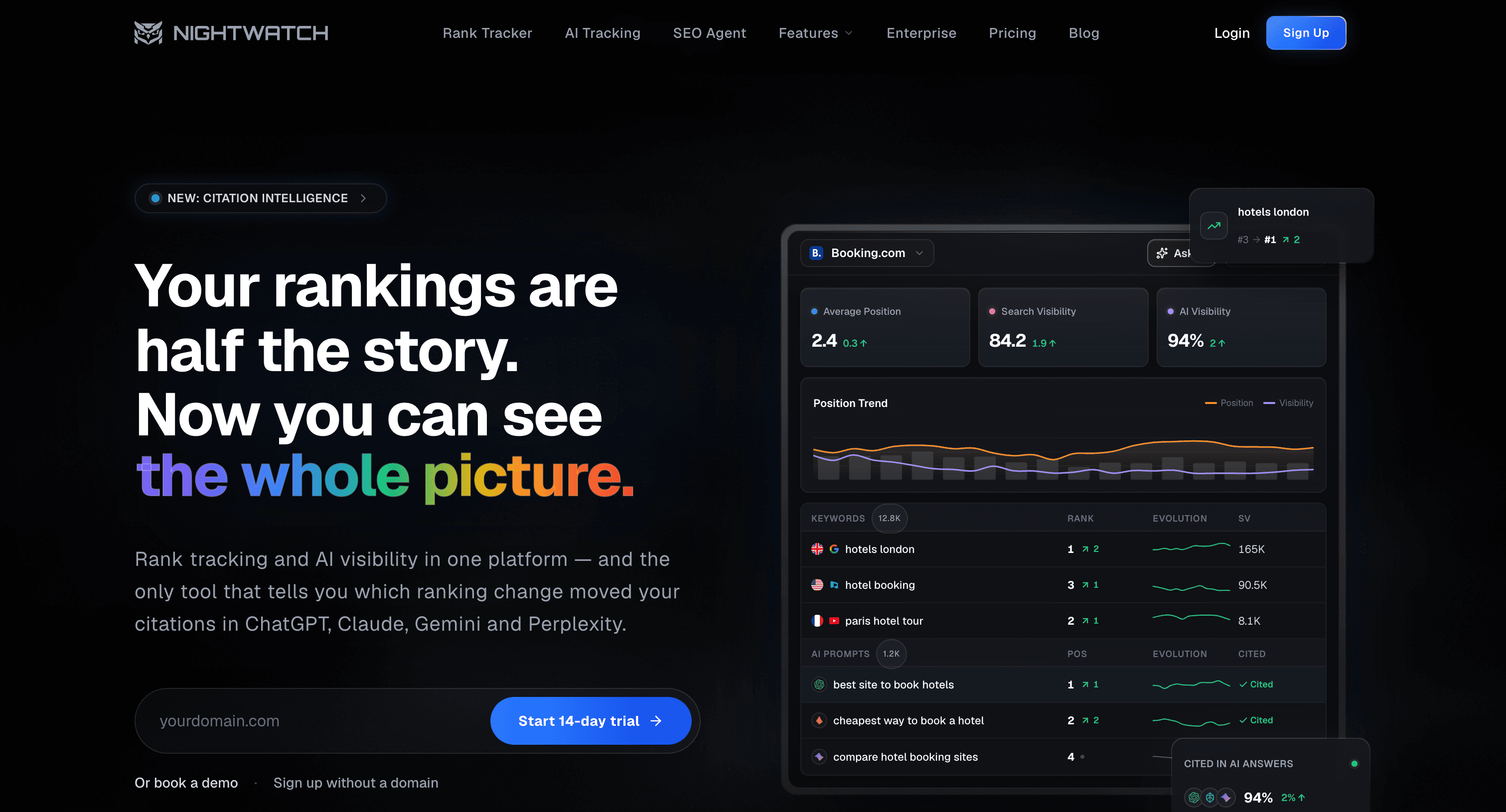
Nightwatch is first and foremost a rank tracker. Starter includes daily tracking for 500 keywords across search engines and locations, unlimited seats, and a 14-day trial without requiring a credit card.
Its AI visibility features cover six platforms and include sentiment and citation analysis. Starter costs €79 a month and includes 50 prompts and 1,500 AI answers per month. Professional costs €159 for 150 prompts.
For businesses that already need daily keyword rankings across hundreds of search terms, Nightwatch offers strong value, and AI tracking is a useful addition. If AI visibility is your main priority, though, much of the subscription is paying for traditional keyword tracking. Grok is also absent from the supported AI platforms.
7. Surfer: AI Search Analytics next to the Content Editor
Surfer is best known as a content optimization platform. In 2026, it added AI Search Analytics to its product lineup.
The feature is available as a standalone plan for €82 a month when billed annually, covering 50 prompts refreshed daily. It’s also included with Surfer’s content plans. The €99 Standard tier, for example, refreshes 25 prompts weekly.
Surfer tracks Google AI Mode, which some competing tools still skip, but it doesn’t currently cover Claude or Grok.
For teams already using Surfer to create and optimize content, keeping AI tracking in the same platform is convenient. As a standalone visibility tracker, however, the €82 plan covers fewer AI platforms than Searcherries Starter and doesn’t include the same analytics integrations.
8. Peec AI: Polished reports for marketing teams
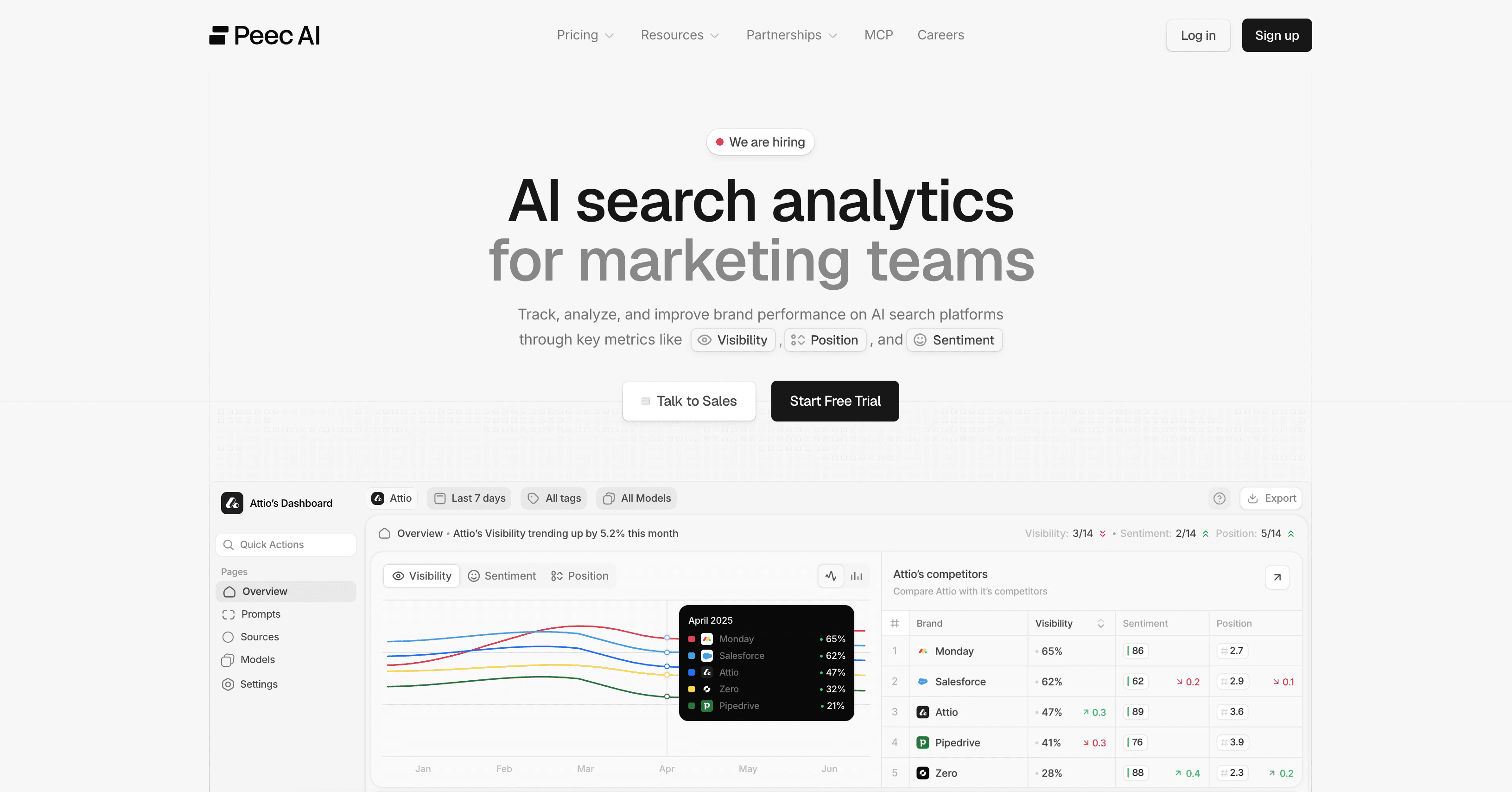
Berlin-based Peec AI has built a strong reputation for its clean reporting, source analysis, and unlimited seats across every plan.
Starter costs $95 a month, or approximately €89, for 50 prompts, one project, and three AI models of your choice. Pro costs $245 for 150 prompts and two projects, while Advanced costs $495 for 350 prompts and five projects. A seven-day trial is available, and annual billing comes with a 15% discount.
Self-serve customers can choose from ChatGPT, Google AI Mode, AI Overviews, Copilot, Perplexity, and Gemini. Claude and Grok are limited to Enterprise, while adding a fourth model requires an additional fee.
Peec AI’s polished reporting is particularly useful when results need to be presented to clients or senior marketing leaders. For a small business tracking a dozen questions for a single brand, though, it may offer more dashboard than necessary at roughly seven times the monthly price of Searcherries Starter.
9. SE Visible: The most prompts per dollar
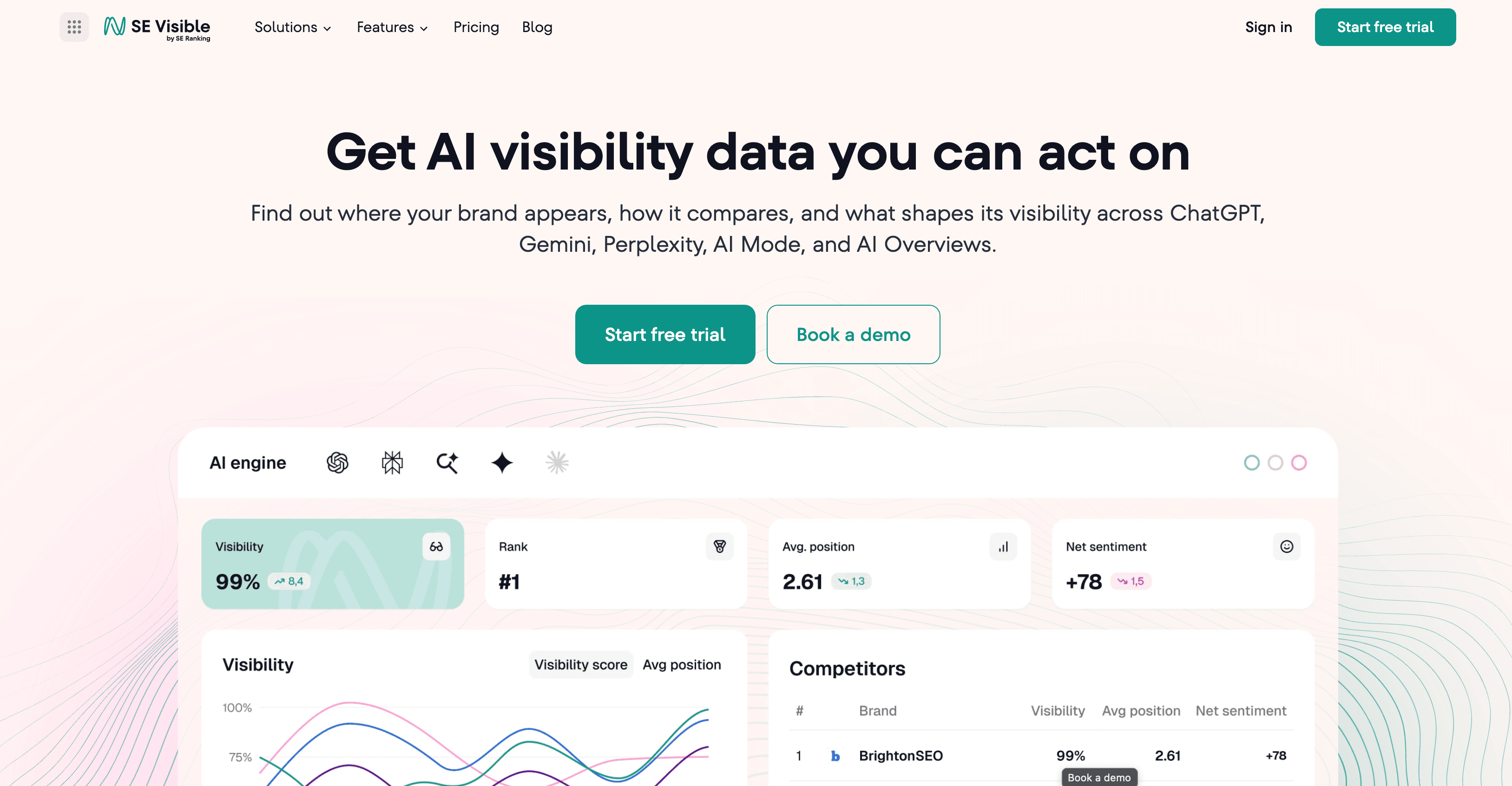
SE Visible is SE Ranking’s standalone AI visibility platform. Basic costs $99 a month, or $79 with annual billing, and includes 200 prompts, three projects, six platforms, unlimited seats, and a 10-day trial. Core increases the allowance to 450 prompts for $189 a month.
Existing SE Ranking customers can add SE Visible within the platform for $89 a month.
On a per-prompt basis, it’s the least expensive option in this guide, making it particularly attractive to agencies and brands that need to monitor long prompt lists.
The tradeoff is the entry price. A business tracking only a few dozen questions may not need 200 prompts, and neither Claude nor Grok is included among the six supported platforms.
10. Semrush One: For teams already in Semrush
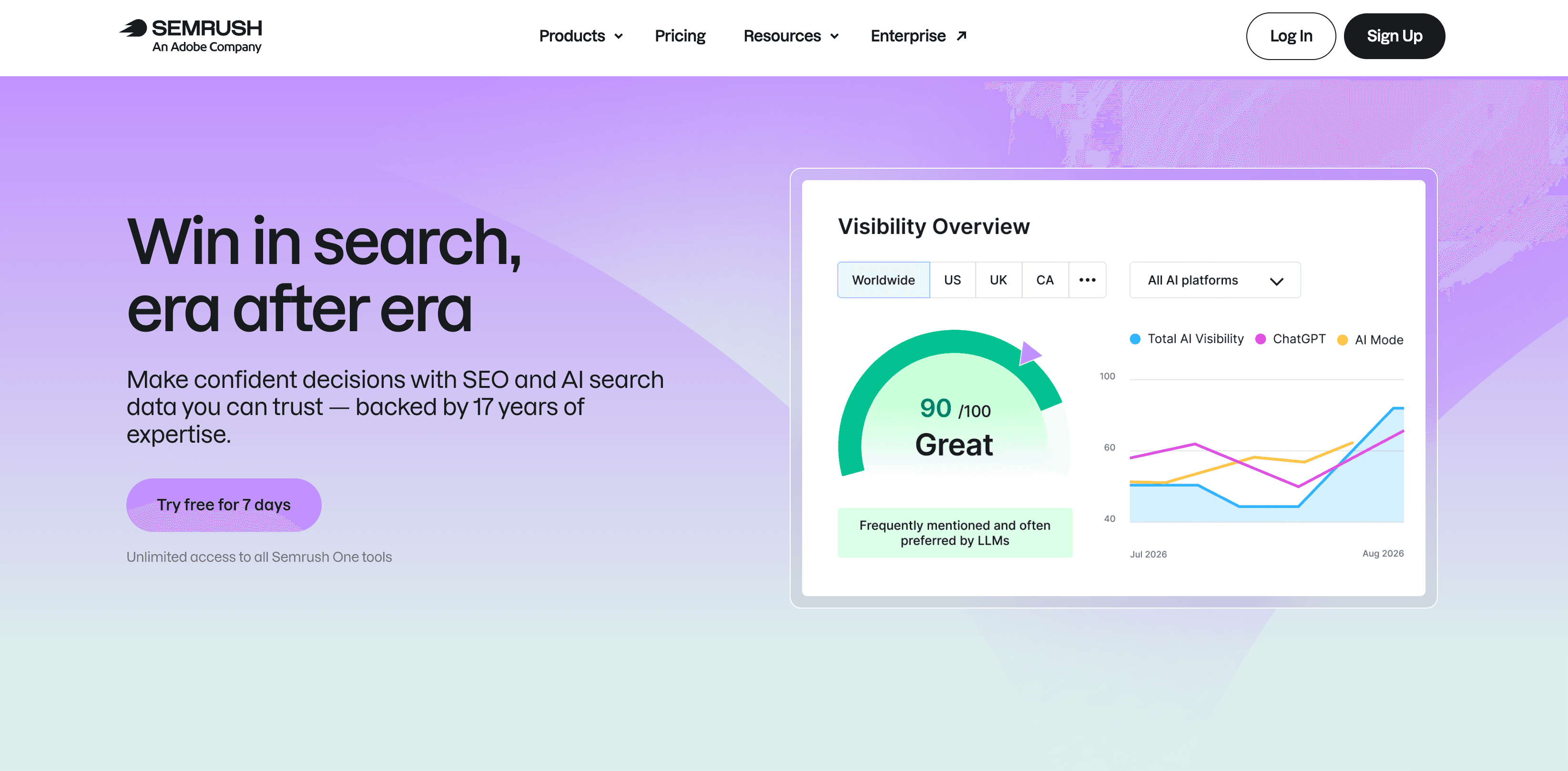
Semrush One includes the AI Visibility Toolkit, which tracks custom prompts daily across ChatGPT, Google AI, Gemini, and Perplexity. It scores AI visibility, identifies the topics and sources influencing answers, and includes Prompt Research based on Semrush’s search database.
The toolkit is also sold on its own for $99 a month per domain with annual billing and includes 25 prompts. Additional users start at $45. Many customers will instead use Semrush One Starter at $199 a month, which combines AI visibility features with the traditional SEO toolkit.
For teams already working extensively in Semrush, keeping AI visibility data inside the same ecosystem makes sense. Costs rise quickly when you add brands or markets, however, because each additional domain requires another $99 license. Claude requires enterprise pricing, and Grok isn’t currently available.
11. Ahrefs Brand Radar: The biggest prompt database, priced per check
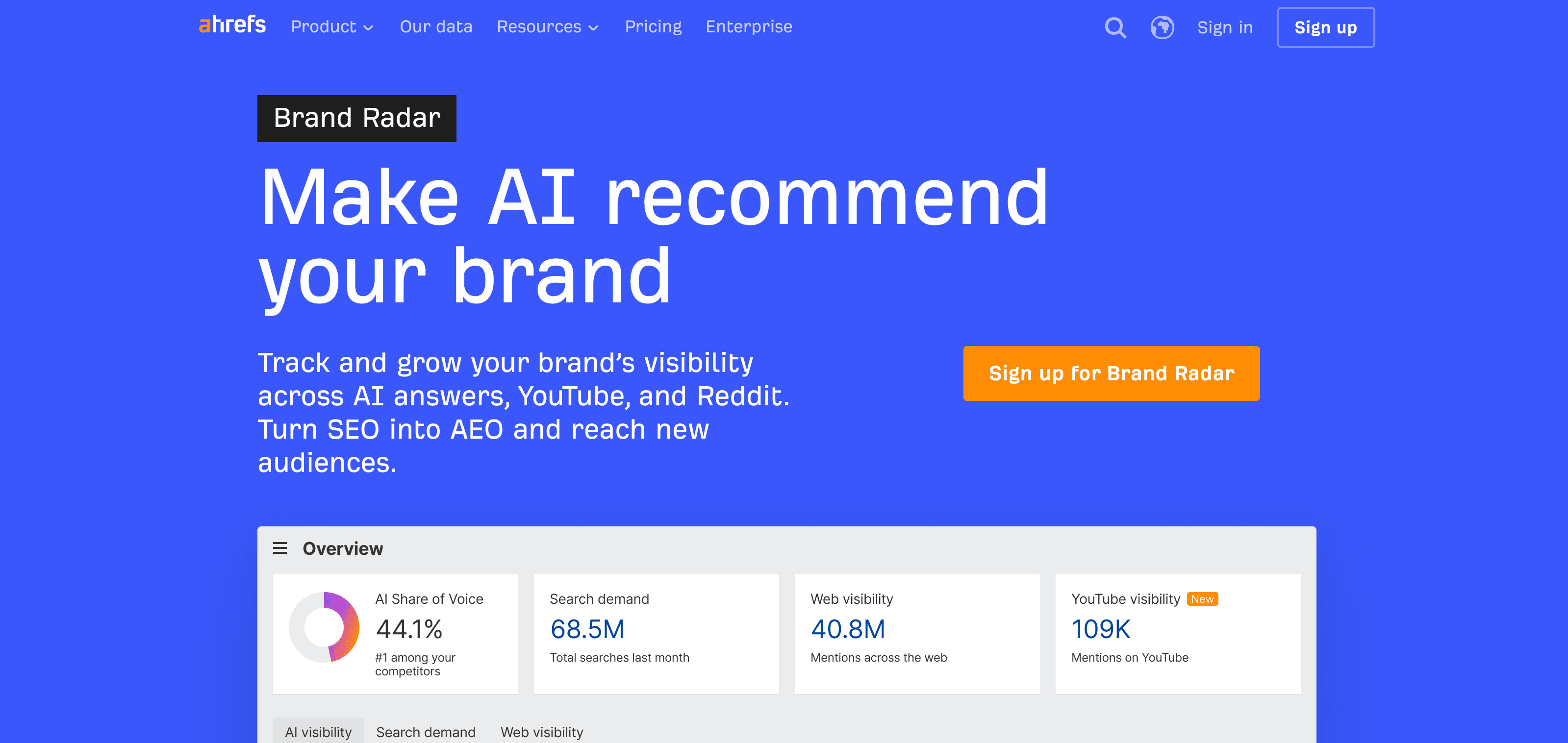
Ahrefs Brand Radar effectively combines two different products under one name.
The AI Visibility Index maps brand visibility across a database of more than 450 million monthly prompts. It costs $199 a month per AI platform, or $699 for access to all of them.
Custom Prompts, meanwhile, tracks questions you choose yourself but requires an existing Ahrefs subscription. The $129-a-month Lite plan includes five prompts and 150 checks. One check represents one prompt, on one assistant, in one location. As a result, tracking 10 prompts across six assistants every day would require roughly 1,800 monthly checks before accounting for Claude’s eight-check multiplier.
For businesses already paying for Ahrefs and interested in understanding which questions people ask AI about their market, the size of its dataset is difficult to match.
For a smaller, focused set of tracked questions, the check-based system makes monthly usage and costs harder to predict. There’s also no free trial.
12. Profound: Built for enterprise teams
Profound is one of the most recognizable names in AI search analytics, but its product is clearly aimed at enterprise brands and agencies.
The platform covers nine answer engines and includes credit-based AI agents, API access, SSO, and dedicated support. There is no self-serve plan or publicly listed price. Its seven-day trial includes 50 prompts across three engines, after which prospective customers need to speak with sales.
For a small business, SaaS startup, or boutique agency, that’s a lot of infrastructure for what may be a relatively simple question: Does ChatGPT recommend us?
Larger organizations may benefit from Profound’s enterprise capabilities, but a team of one or two marketers is likely to pay for far more platform than it will regularly use.
Free AI visibility tools to set up first
You can probably guess some of the tools we’re going to recommend here. They’re the ones most website owners should already be using, regardless of which paid AI visibility tracker they choose.
Google Search Console Generative AI features
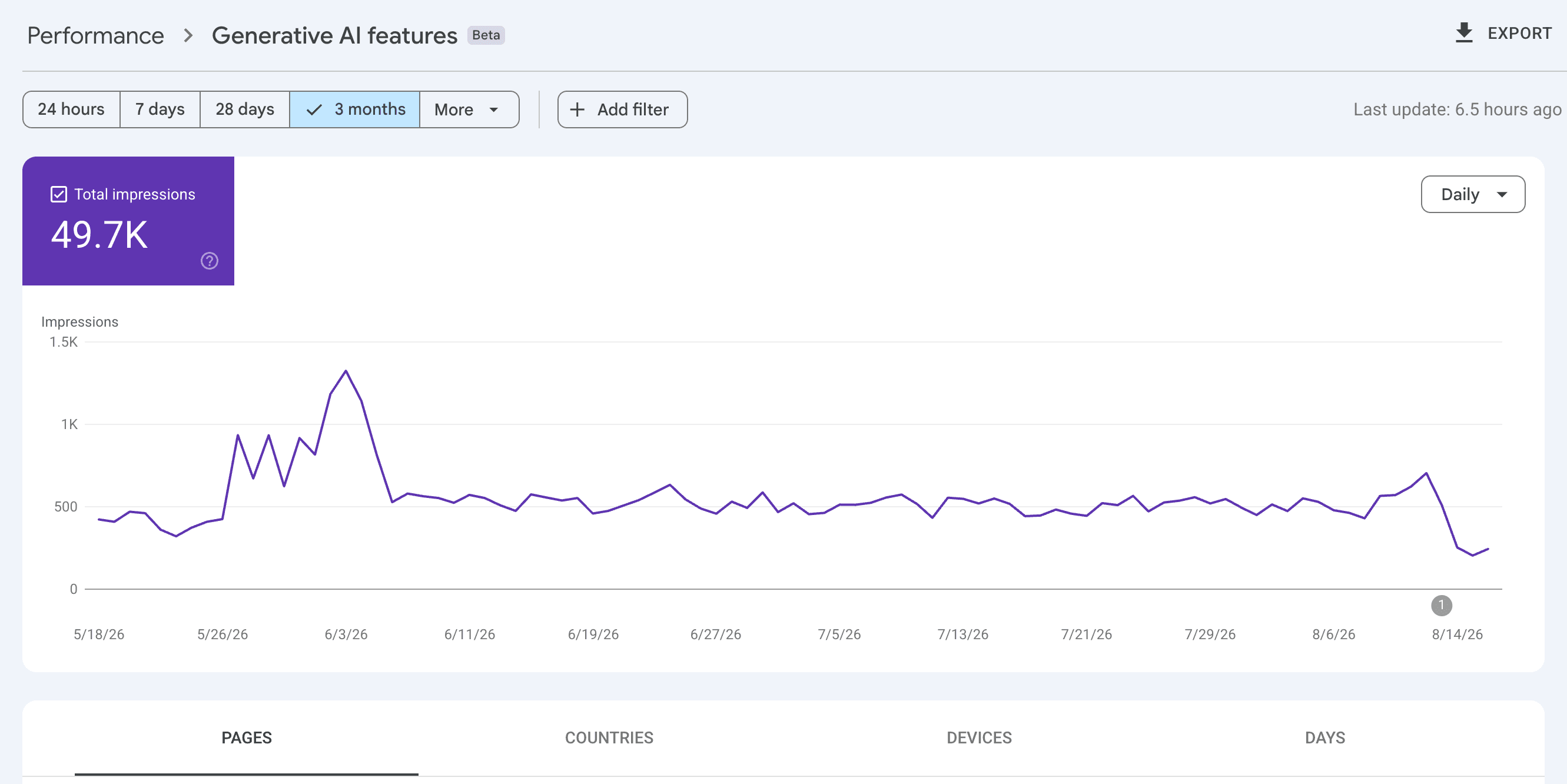
Google has started giving website owners information about how their sites perform in generative AI search, including AI Overviews. The available data is still limited, particularly compared with some dedicated tracking platforms, but even a partial view is useful.
First, connect and verify your website in Google Search Console. We recommend doing this regardless of whether you plan to track AI visibility.
Under Performance, you’ll find the Generative AI features section. From there, you can monitor overall impression trends and view breakdowns by page, country, and device.
Bing Webmaster Tools AI Performance
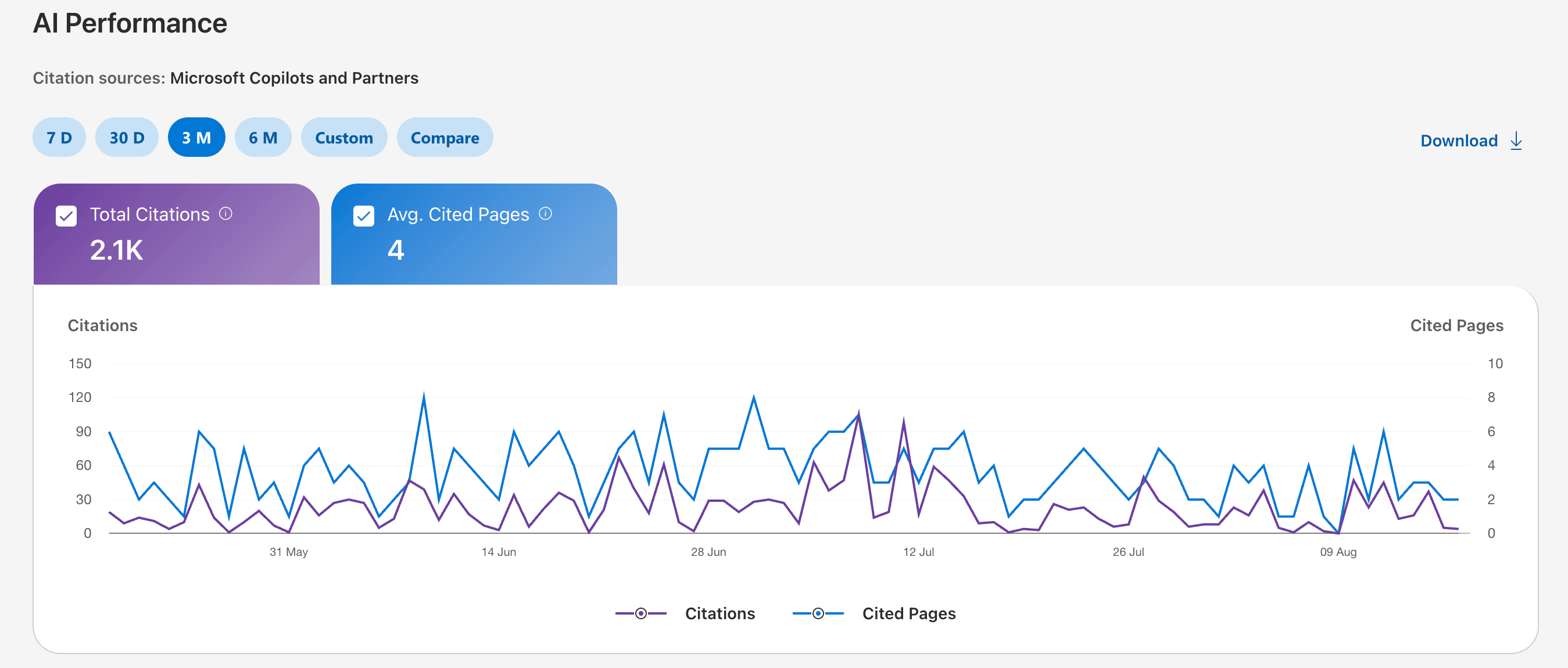
Bing was the first major search engine to introduce a dedicated tool for measuring website performance in AI search. Its launch also raised expectations for the kind of information search engines could make available to website owners.
Bing’s reporting is considerably more detailed than Google’s. You can view the queries associated with your site, their intent, the number of citations received during a selected period, and your citation share.
We’d be tempted to rank Bing Webmaster Tools AI Performance first among the free options if Google weren’t still the dominant source of organic traffic for most businesses.
Even so, Bing Webmaster Tools is worth connecting to your site regardless of whether you eventually pay for a dedicated AI visibility platform. Bing is easy to underestimate, but the AI performance data alone gives website owners a good reason to use it.
Microsoft Clarity
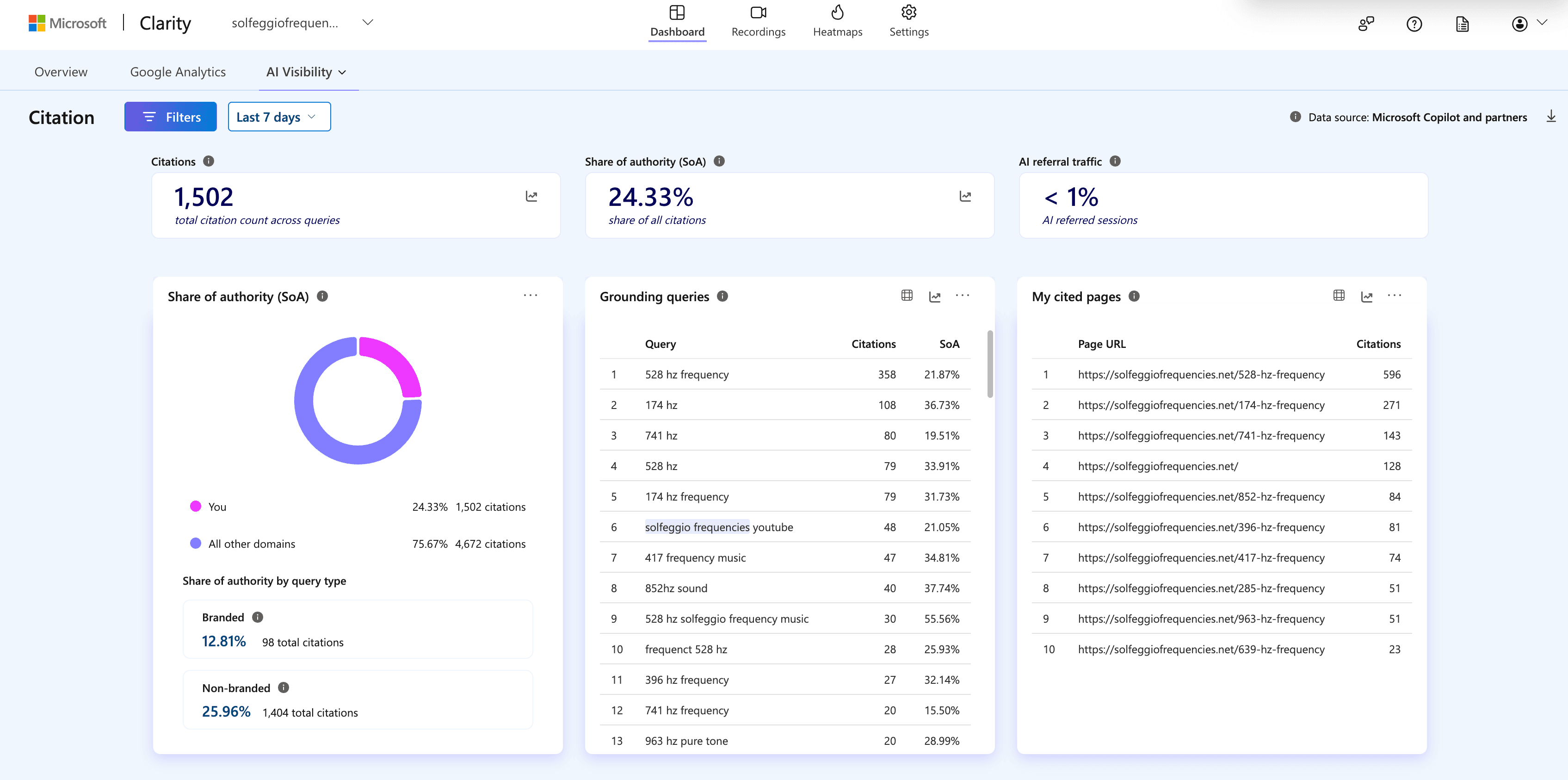
Microsoft Clarity provides another free way to understand how AI systems interact with your website.
Its AI visibility reporting includes information about pages from your site that appear as citations in Microsoft Copilot, along with data about AI bots visiting your website.
Combined with Bing Webmaster Tools, it gives you another useful layer of information without adding to your software budget.
Free AI Visibility Checker by Ahrefs
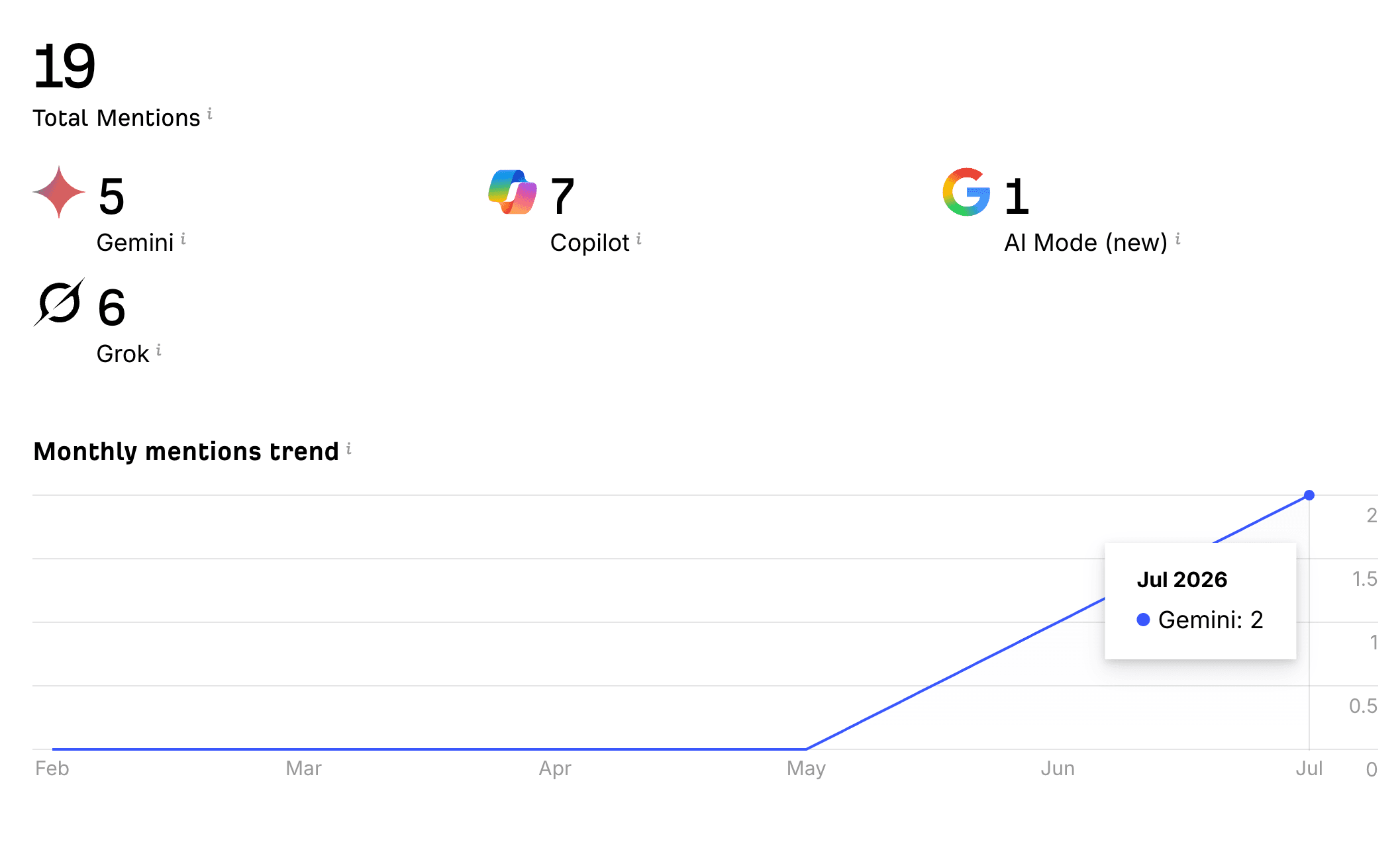
Ahrefs is already one of the most widely used SEO platforms, so its investment in AI visibility is a natural extension of the product.
The company monitors an enormous volume of AI prompts, with its database now covering more than 450 million prompts per month.
Its free AI Visibility Checker gives you a broad overview of which AI platforms mention your website and how frequently your brand appears across AI search.
Paid Custom Prompts tracking through Brand Radar requires an Ahrefs subscription, but the free checker can still provide a useful high-level view without the cost of a paid visibility platform.
Free AI Visibility Tool by Semrush
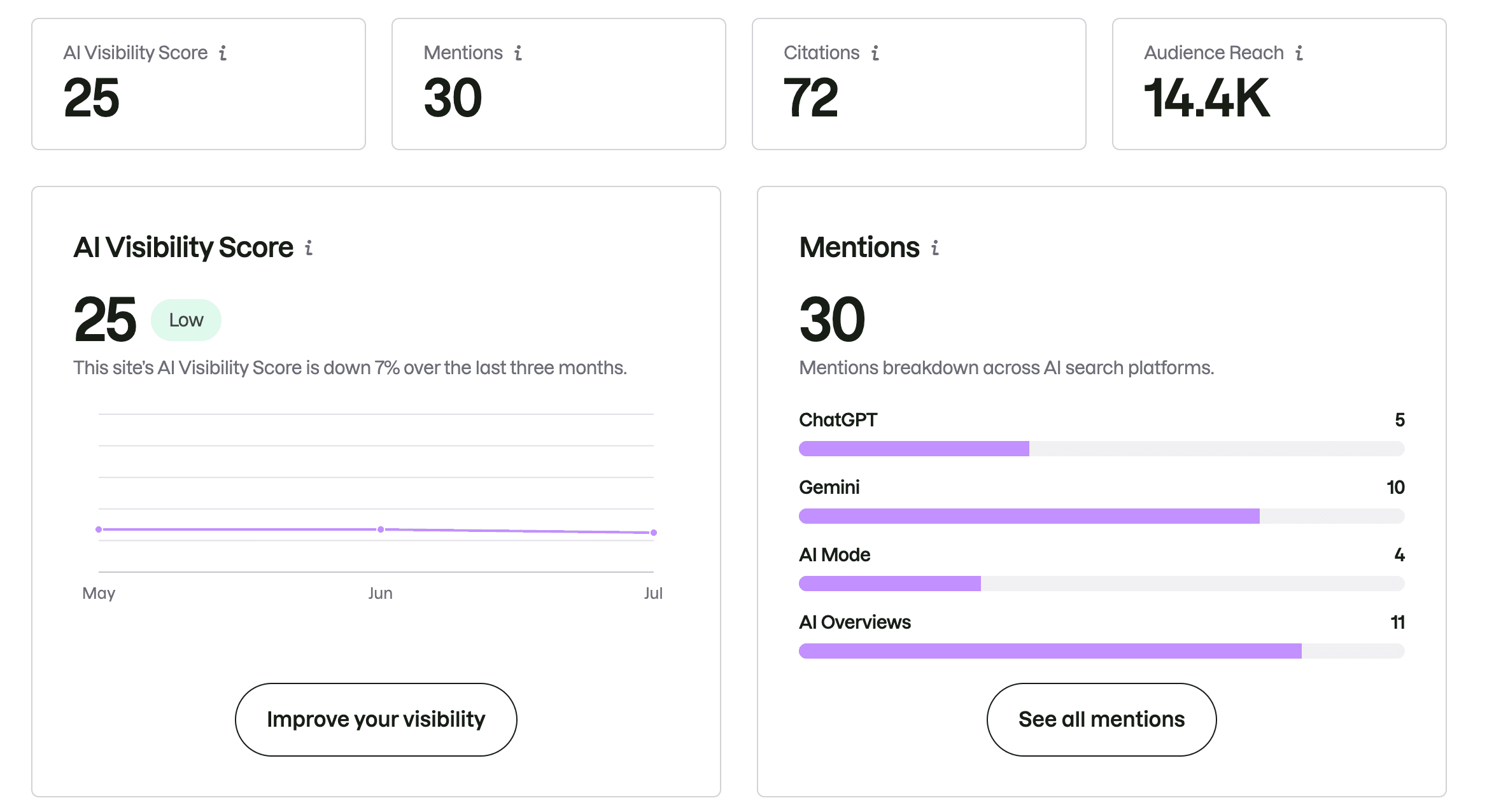
Semrush is another familiar name among SEO professionals, although the platform now covers far more than traditional search optimization.
For many small businesses, a full Semrush subscription may be more than they need. The company’s scale, however, allows it to collect substantial amounts of AI citation data across a large number of prompts.
The free AI Visibility Tool shows where your site appears in AI search, along with your most visible pages and the topics for which your website is cited most often.
That information alone can help you understand where you already have a foothold in AI search and where there may be room to improve.
None of these free tools track your own questions on a recurring schedule. That’s the main job paid AI visibility platforms perform.
Searcherries brings Search Console and Bing data into the same project as your tracked AI answers, which means the two free tools we recommend most can continue contributing useful data inside the platform.
Which AI visibility tool should you choose?
If you run a small business, SaaS team, or small agency, Searcherries is a strong place to start. For $10 a month with annual billing, you get tracking across six AI platforms, GA4, Google Search Console, and Bing data in one project, plus an MCP server your AI assistant can access.
The free tools are worth setting up too. They cost nothing, and two of them integrate directly with Searcherries.
Other platforms make sense for more specific needs. Otterly is a good choice for daily tracking across a short prompt list. Frase and Surfer are better suited to teams that also want content writing and optimization tools, while SE Visible offers greater value when you need to track hundreds of prompts.
And if Ahrefs or Semrush is already central to your SEO workflow, there’s nothing wrong with keeping AI visibility tracking in the platform you already know and pay for.